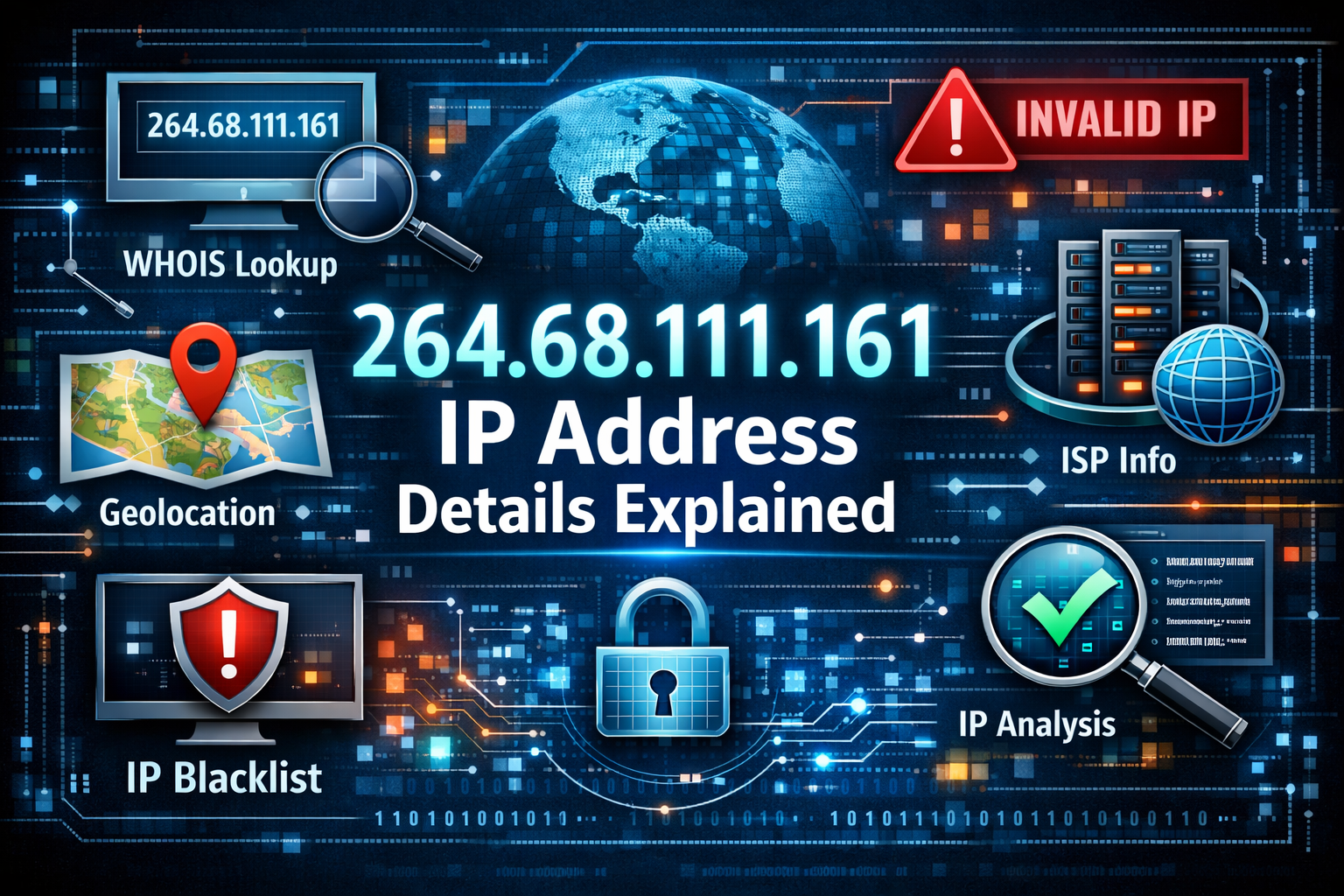
264.68.111.161 IP Address Details Explained
Introduction
If you searched for 264.68.111.161, you’re probably trying to understand who owns this IP address, where it is located, whether it is safe, and what it means from a networking perspective. In this in-depth guide, we’ll break down everything you need to know about this IP address using clear explanations and technical insight.
We’ll cover:
- What an IP address is
- Whether 264.68.111.161 is valid
- How IP address ranges work
- Geolocation and ISP ownership
- Security, blacklist, and reputation checks
- IPv4 limitations and reserved ranges
- How to properly check and analyze any IP address
Let’s begin.
What Is an IP Address?
An IP address (Internet Protocol address) is a unique numerical label assigned to devices connected to a network that uses the Internet Protocol for communication. It serves two primary purposes:
- Identifying a host or network interface
- Providing the location of the host in the network
The most common format is IPv4, which consists of four numbers separated by dots (for example: 192.168.1.1).
Each of those four numbers is called an octet.
Understanding IPv4 Structure
An IPv4 address follows this structure:
X.X.X.X
Each “X” must be a number between:
0 – 255
This means:
- The minimum possible IPv4 address: 0.0.0.0
- The maximum possible IPv4 address: 255.255.255.255
There are exactly 4.3 billion possible IPv4 addresses.
Is 264.68.111.161 a Valid IP Address?
Now let’s analyze:
264.68.111.161
Breakdown:
- 264
- 68
- 111
- 161
Here’s the problem:
An IPv4 octet must be between 0 and 255.
But:
264 > 255
This means:
👉 264.68.111.161 is NOT a valid IPv4 address.
It cannot exist on the public internet because it violates the IPv4 addressing rules.
Why 264 Is Invalid in IPv4
IPv4 uses 8 bits per octet.
An 8-bit number can only represent:
0 to 255
Binary explanation:
- 8 bits = 11111111
- Decimal value = 255
Anything above 255 cannot be represented in a single IPv4 octet.
Therefore:
264.68.111.161 fails IPv4 validation immediately.
What Happens If You Try to Use This IP?
If you:
- Try to ping it
- Enter it into a browser
- Run a WHOIS lookup
- Check it in an IP geolocation tool
You will receive errors such as:
- Invalid IP address
- Host not found
- Unable to resolve address
That’s because networking systems automatically validate IP formatting before attempting connection.
Could It Be IPv6?
Another question is whether this could be an IPv6 address.
IPv6 looks completely different. Example:
2001:0db8:85a3:0000:0000:8a2e:0370:7334
IPv6 uses hexadecimal characters and colons — not dot-decimal format.
So:
❌ 264.68.111.161 is NOT IPv6
❌ It is NOT valid IPv4
✅ It is simply an invalid IP string
How to Properly Check an IP Address
When analyzing a valid IP address, you would typically check:
1. WHOIS Information
Shows:
- ISP
- Organization
- Allocation details
- Country
2. Geolocation
Provides:
- Country
- Region
- City
- Approximate coordinates
3. Reverse DNS
Checks if a domain is mapped to the IP.
4. Blacklist Status
Important for:
- Spam detection
- Email server checks
- Cybersecurity investigations
5. ASN (Autonomous System Number)
Identifies the network operator.
But again — since 264.68.111.161 is invalid, none of these checks will return legitimate results.
Common Reasons People Search Invalid IPs
There are several reasons someone might search an invalid IP address like this:
1. Typing Mistake
It’s very common to accidentally type 264 instead of 164 or 204.
2. Log File Error
Some poorly formatted logs may contain corrupt IP data.
3. Fake Data in Spam or Scam Messages
Cybercriminals sometimes include random numbers to appear technical.
4. Testing or Placeholder Data
Developers sometimes use fake IP formats in examples.
What Would a Similar Valid IP Look Like?
If the first octet were valid, examples might include:
- 164.68.111.161
- 204.68.111.161
- 216.68.111.161
These would pass IPv4 validation because all octets are within 0–255.
Understanding IP Classes
IPv4 addresses are divided into classes:
Class A: 1.0.0.0 – 126.255.255.255
Class B: 128.0.0.0 – 191.255.255.255
Class C: 192.0.0.0 – 223.255.255.255
Since 264 is outside this range entirely, it doesn’t belong to any IP class.
Reserved and Special IP Ranges
Here are some special ranges:
Private IP ranges:
- 10.0.0.0 – 10.255.255.255
- 172.16.0.0 – 172.31.255.255
- 192.168.0.0 – 192.168.255.255
Loopback:
- 127.0.0.1
Broadcast:
- 255.255.255.255
Again, 264 cannot exist in any reserved or public category.
IP Address Reputation & Security
When analyzing a real IP, security professionals check:
- Spam activity
- Botnet association
- Malware hosting
- Phishing campaigns
- DDoS participation
Invalid IP addresses like 264.68.111.161 cannot be associated with real security threats because they cannot be assigned to any device.
IPv4 Exhaustion and Modern Context
IPv4 address space is nearly exhausted globally.
That’s why IPv6 was introduced to provide:
- 340 undecillion possible addresses
- Better routing efficiency
- Improved network configuration
However, IPv4 still dominates most public internet usage today.
How to Validate an IP Address Yourself
You can manually validate by checking:
- Are there exactly 4 numbers?
- Are they separated by dots?
- Is each number between 0 and 255?
- No extra characters?
If any octet exceeds 255, it is invalid.
Summary
Let’s recap:
- 264.68.111.161 appears to be formatted like an IPv4 address
- The first octet (264) exceeds the allowed maximum of 255
- Therefore, it is not a valid IP address
- It cannot be geolocated, traced, or assigned
- It likely results from a typo, corrupted data, or placeholder input
Final Verdict
264.68.111.161 is not a real or valid IP address.
If you encountered this IP:
- Double-check for typing errors
- Review logs for data corruption
- Verify the original source
If you want help analyzing a real IP address, feel free to share it and I can provide a detailed breakdown including geolocation, ISP details, and security insights.



Post Comment