United Flight UA967 Diverted to St. John’s After Delay
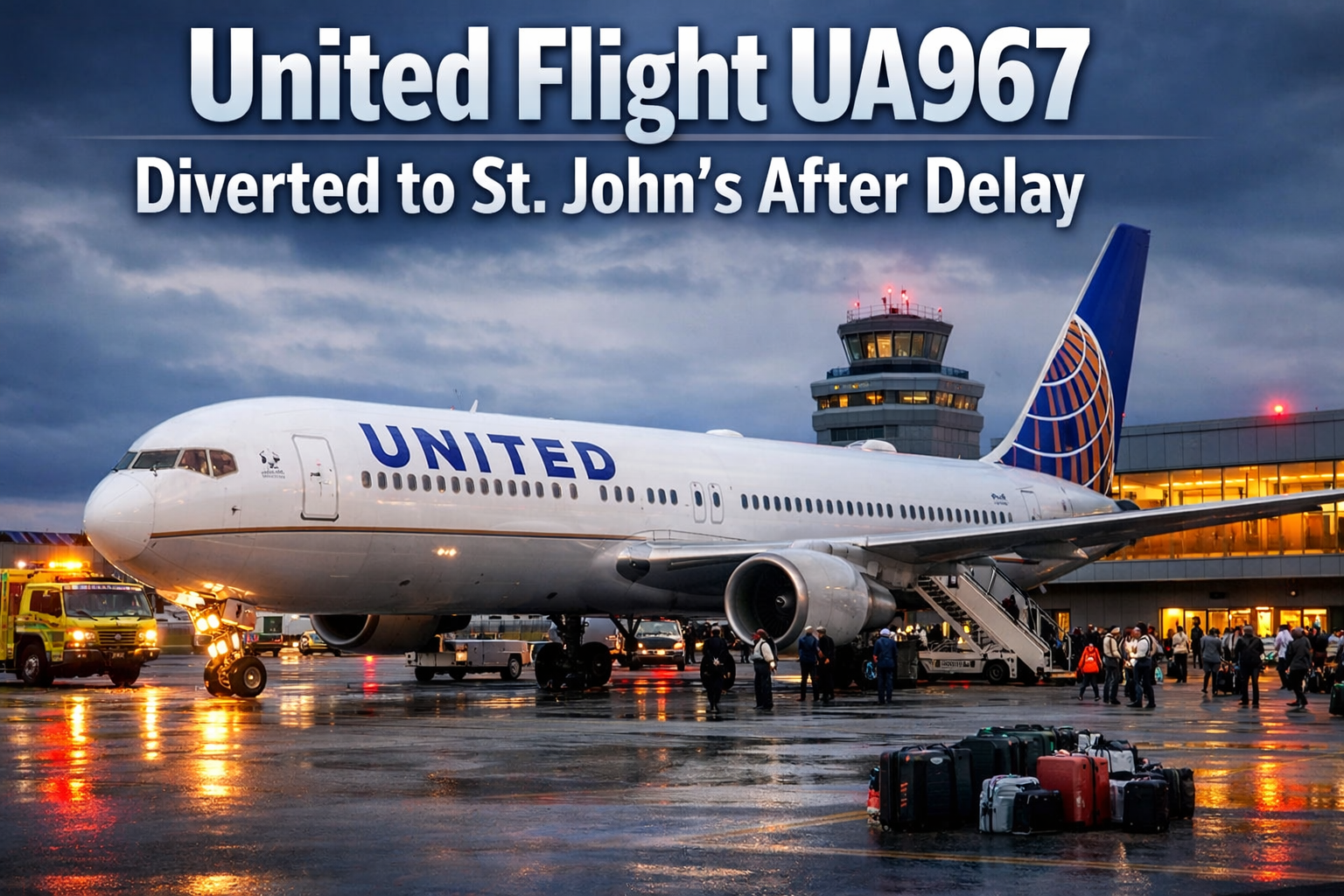
In a notable disruption to transatlantic travel, United Airlines Flight UA967 en route from Naples, Italy to Newark, New Jersey, USA was delayed and ultimately diverted to St. John’s International Airport in Canada. The unexpected change in route left passengers facing significant delays and raised questions about flight safety and airline operations.
On Sunday, August 24, 2025, United Airlines flight UA967 departed Naples International Airport from gate B10 at approximately 17:13 Central European Summer Time (CEST), but not without complications. The Boeing 767‑300ER aircraft scheduled for the journey was already three hours late at departure. It initially returned to the gate moments after starting the takeoff roll, suggesting something was wrong even before the long transatlantic crossing began.
After the late departure and an extended flight westward across the Atlantic Ocean, the aircraft was unable to complete its journey to Newark. Around 20:25 local time (8:25 PM), the flight crew made the decision to divert and land at St. John’s International Airport in Newfoundland and Labrador, Canada — located on the easternmost edge of North America.
Why Did UA967 Divert?
The official reports state the Boeing 767 had to divert “for a technical reason.” While the airline has not publicly released detailed specifics about the nature of the issue, diversions like this typically occur when a plane experiences mechanical issues, navigational concerns, or system warnings that cannot continue safely without inspection. It’s worth noting that in long over‑water flights, aircraft follow strict safety protocols; if anything appears out of order, diverting to the nearest suitable airport is standard.
There are a few general reasons flights are diverted:
- Mechanical or technical problems with aircraft systems.
- Crew rest or timing out (for long flights, rules limit how long pilots and cabin crew can operate).
- Weather conditions preventing safe landing at the destination.
- Medical emergencies onboard requiring immediate attention at the closest airport.
- Air traffic control restrictions or unexpected closures at the intended destination.
While the specific technical problem with UA967 has not been confirmed, a diversion is ultimately about prioritizing the safety of passengers and crew.
What Happened After the Landing at St. John’s?
Once the flight landed at St. John’s — which is not a scheduled destination for this United flight — passengers disembarked, and the airline arranged for another aircraft to continue the journey. According to flight tracking data, United eventually resumed the flight with a second Boeing 767 (tail number N673UA). This replacement aircraft carried the passengers to Newark Liberty International Airport in the early morning hours of Monday, August 25, arriving over ten hours later than originally scheduled.
Such a switch is relatively common in major diversions: airlines often must position a replacement aircraft from another route or base once a plane has landed unexpectedly away from its home destination.
Where Is St. John’s and Why Was It Chosen?
St. John’s International Airport (YYT) situated in the capital of Newfoundland and Labrador — is one of the easternmost major airports in North America. Its location makes it a practical diversion point for flights crossing the North Atlantic, particularly when the flight is still in the early or middle portion of the crossing. St. John’s has the runway capacity, navigation equipment, and services needed to handle large wide‑body aircraft like Boeing 767s traveling between Europe and the United States.
The airport serves as a designated diversion option under ETOPS (Extended Operations) rules, which govern where twin‑engine aircraft can fly when operating far from a diversion airport. Because UA967 was well over the ocean when the issue became apparent, the crew chose the nearest safe diversion point which in this case was St. John’s.
Passenger Experience and Airline Response
Passengers aboard UA967 experienced an unexpectedly long travel day, with initial departure delayed, followed by an unplanned landing in Canada. While no injuries or serious emergencies were reported, the diversion added many hours to a journey that normally would take around eight hours.
In situations like this, airlines typically offer:
- Rebooking options on alternative flights.
- Meal vouchers or accommodation if overnight stays are necessary.
- Assistance with onward connections and customer service support.
Exact details of compensation or vouchers provided by United for this particular flight were not publicly disclosed.
How Often Do Flights Divert?
While diversions grab headlines due to their dramatic nature, they are relatively rare in commercial aviation. Most long‑haul flights complete without incident. Industry data suggests that diversion percentages overall even for large carriers are well under 1% of total flights. The U.S. Department of Transportation reported that for most major carriers, diverted flights made up a tiny fraction of total operations in typical reporting periods, though each case is unique and based on individual circumstances.
Some United flights have faced similar issues in the past, including diversions for mechanical reasons or medical emergencies. However, these are isolated cases rather than a pattern of recurring problems.
Aircraft and Older Fleet Considerations
The aircraft involved, a Boeing 767‑300ER with registration N671UA, is part of United’s older wide‑body fleet many of which are over 20 years old. Older aircraft are still commonly used in airline fleets and maintained under strict regulatory oversight. Diversions due to minor technical anomalies can occur even on newer aircraft as part of the robust safety‑first practices in aviation.
Conclusion
The diversion of United Flight UA967 to St. John’s highlighted both the complexities and safety‑oriented nature of modern commercial aviation. While delays and unscheduled landings are inconvenient for travelers, they are part of a system designed to handle uncertainties with caution and care.
Passengers on this flight were ultimately transported safely to their destination albeit many hours later than ploccur and without any reported injuries. The incident underscores the importance of safety protocols and the readiness of diversion airports like St. John’s to support transatlantic traffic when the unexpected occurs.




Post Comment